
By Caroline Ashley
There was a patch of air where the light refracted and danced like fireflies. The movement drew Joe McMillan forward like a moth, unable to look away. He pulled out his phone to record a video, but his camera couldn’t capture the true essence of the flickering movement.
Joe’s stomach lurched like he was peering over a cliff edge. He stood in the Meadows, a large park just south of Edinburgh’s city centre. This was always his route home, a familiar comfort after a long day, and somehow it felt tainted. He feared the beauty of the light disguised a poison underneath.
To his right, uniformed men in black approached the flickering anomaly, chests covered in armoured vests and weapons holstered at their hips, their authority as certain as the rising of the sun.
They herded him away and constructed a transparent box around the space, carefully ensuring not to step too close. Their makeshift prison concealed the subtle distortion, though the surface flickered with reflected movement.
Next came a metal shipping container, the walls rising to enclose the space entirely. Once their task was complete, the men stood sentry around the building’s walls, humans forming the final layer of defense.
Joe’s discovery was encased like an industrial nesting doll.
A few others had gathered nearby, watching the construction with their phones raised.
“Hey, what’s going on here?” one man asked.
A woman pointed her camera at a guard’s face. “We have a right to know what you’re hiding in there.”
“Do you work for O’Neil?” came another voice.
Everyone knew Arthur O’Neil. He sat in news interviews wearing his satin three-piece suits, hair slicked back and glistening like slug trails in the sun. When he spoke, he would spray spittle at the camera lens as he paced the room, arms attempting to encapsulate the breadth of his ire at the state of the world. Arthur O’Neil acted like he was certain that he knew best. He treated his audience as if they were misbehaving toddlers who he had to force into line.
No one knew where he came from. One day he appeared, a self-made millionaire, and predicted all the details of Chernobyl and the Challenger explosion right before they happened. It was too late to prevent them, but Joe was certain that had been his intention. He wanted to prove himself, to ensure people believed the importance of his words. He wanted to be the pied piper, leading willing rats out of the village and lauded him for his achievements.
The government tried to lock him away, and interrogate him, but he had surrounded himself with an army of lawyers. Now he was one of the most powerful people in the world.
Joe’s watch vibrated, reminding him of a dinner date with his wife, Ashley. She always had plenty to say about O’Neil.
He could still picture the sparkle of light drifting through the air, shining like a gas cloud deep in the vacuum of space. Shaking his head, he cast the image from his mind and pushed past the crowd that was forming around him.
***
The morning sun stretched its fingers across Joe’s wooden floor. Photographs of Ashley and his adventures across Europe lined Joe’s path to the kitchen.
He had never planned to travel – his father had an inherited career in the police all lined up for him. But he and Ashley turned eighteen just as the government introduced the universal wage and they thought, Why not?
Two decades ago, he had stood on a balcony at Neuschwanstein Castle in Bavaria, surrounded by whispering trees and snow-peaked mountains, and realized that his father’s footsteps were impressions in powdered snow, easily swept away.
As Joe opened the fridge to search for eggs, he hummed a tune. Ashley stopped in the doorway, tying the cord of her dressing gown. “What is that?”
“What’s what?” Joe asked.
“That song.”
He paused to think, thumb tapping on the fridge door. “Must have heard it on the radio.”
“I heard someone at work sing it too, but they didn’t know the name either.”
Echoes, some people called them. Fragments of songs and snippets of conversations, haunting the ether and drifting into people’s consciousness. Some believed they were voices from a different timeline, one without O’Neil. Some said it was just déjà vu, and the experience had been twisted into more than it was by the social media echo chamber.
Ashley said she had never felt one. In Vienna, she had perched on the edge of a bar stool and declared herself free of the shackles of fate. “I don’t need any signs from the universe that I’m following some predetermined path.”
She chugged back the dregs of her beer and pulled him up to dance. Her cheeks were rose pink and she moved like a bird launching into flight, ready to follow the call of the wind.
I miss those days.
“Judith Alexander is doing a talk tonight at the University,” Ashley said. “Do you want to come with me?”
“Judy Alexander? Is it not her who sings that song?”
Years ago, he watched the X Factor with Ashley and had been sure afterward that a woman from Edinburgh was the winner, even though no one from Edinburgh competed. A lot of people online had thought the same. Was Judy Alexander her name?
“No, she’s a physicist. The one I told you about with all the theories about O’Neil.”
Joe held back a sigh. He focused his attention on frying eggs. “Why does it matter so much?”
She raised her hands in the air, tension rising through her limbs. “How he got here… how he knows what he does… it changes our understanding of the universe.”
Joe shrugged. In this age of prosperity, a contented life was as easy to achieve as opening the fridge for a beer.
Instead of the police, he worked in social care, a role he had never considered until he broke free of his father’s shadow. Ashley, on the other hand, had flitted from one job to the next, an anxious hummingbird trying to source enough nectar to sustain herself. He had wanted to build a family with her, but she had never felt ready and had treated the creation of a child like consigning a convict to death row.
A picture above her head in their kitchen showed her gleaming ivory teeth, eyes shining like fireflies, as she held a shot of milky ouzo to the camera. She didn’t care about the universe back then; was content with the experiences life offered her. If only he could catch that feeling and hold it captive for Ashley so that she wouldn’t have to keep searching for it.
He turned back to the eggs, gaze fixed on the bubbling egg whites. “Yeah, we can go if you want.”
***
Joe and Ashley crossed the Meadows to reach the University. Barriers had been erected around the new structure, spotlights marking the boundary. A crowd of people surveyed the building, and they were largely ignored by the stoic guardsmen.
Joe pulled out his phone to check the local news as he walked – the articles he found called it a research station, conducting scans of the soil.
Social media was certain this was a lie.
Some people had seen the anomaly and believed O’Neil had paid the government to hide a time portal, restricting access to the means by which he had created this world.
“Did you see he’s releasing his memoir in a couple of weeks?” Ashley asked.
“Who?”
“O’Neil.” She rolled her eyes at his question – there was no one else whose memoir would interest her.
Ashley had increasingly struggled with O’Neil’s existence. When she allowed herself a moment of contemplation, she often said that it felt as if the ground vanished beneath her, leaving her falling, swimming, reaching outward for a life vest that never came. Her mind was an unanchored ship and every second of lapsed attention sent her drifting further out into the midnight depths.
O’Neil’s most recent major prediction had been uploaded to all of his social media accounts four years ago. He sat, alone, hands clenched together to obscure the trembling of his limbs. Time had drawn lines across his face, and bent his body forward under its weight. His brown eyes stared straight into the camera, a circle of white LEDs reflected across his irises.
He predicted a pandemic and he shared the tools needed to develop a vaccine.
Ashley had watched the man’s address to the nation with a scowl of distaste. O’Neil sought to shape the world in the image that he had chosen, a puppet master directing his creations. Ashley railed against his control and refused to inject herself with any vaccine inspired by his words – not that it mattered when the majority of the population followed him like loyal rats.
The latest publications suggested that the nCov-19 virus wasn’t nearly as deadly as O’Neil said it would be. Ashley had seen that as vindication of her actions; Joe was just grateful there was nothing to worry about.
Joe reached for her hand, entwining his fingers with hers. “You going to read it?”
Ashley lifted a shoulder in feigned indifference. “Maybe.”
Joe lowered his head against hers, eyes drifting to the metal cage once more, his stomach twisting with unease.
***
Judith Alexander stood at a wooden lectern, her colleague Ben Anderson at her side. The woman was a vision of sharp edges, golden hair brushed tightly against her scalp as if she had wanted to tear it from her skull. Her companion was a hunched shadow, eyes locked on his tablet as she spoke.
Joe could swear he knew both of them as he watched from the rear of the lecture theatre.
Judith seemed as broken as Ashley sometimes did. A vase fractured and pieced together but never quite the same again. She presented her theories with the anger of a scorned lover.
Fifteen minutes proclaiming that the rules of physics as humans knew them were proof against any earth-based time travel. Einstein-Rosen bridges would tear the earth apart with the strength of their gravitational pull. Quantum tunneling predicted the possibility of a particle moving in time, but the world would be waiting until the end of the universe for probability to allow for the movement of a human being.
And then, the juxtaposition of the scientific facts with her own certainty that time travel was the only explanation for Arthur O’Neil’s existence. She drew a picture of a line, had the line double back to halfway along, and then sent it off on a sideways angle. But what if Arthur wasn’t the only traveler? She doubled back on the branch and sent another line on its own path through space. Then again, then again. Her hand shook as she pressed the lid back on her pen and turned to face the audience.
“The echoes are proof. You find yourself in the same time, the same place, as another version of yourself and you hear someone speak who isn’t there. You find yourself thinking something that doesn’t make sense. You hear a song that no one knows.”
Ashley flinched at the woman’s words. The older she got, the more it seemed to bother her. Joe had never understood why it was important – the echoes were just an irritation, like interference on a radio. What difference did it make?
They were slow to leave, one of the last in the queue from the lecture theatre. Judith was leaving the building at the same time they were. Her eyes were fixed on the ground, shoulders hunched forward.
Ashley waved to get her attention. “Dr Alexander? Dr Alexander?”
She reached out to tap Judith’s arm when it looked like the woman wasn’t planning to stop. Judith jumped back as if she had been bitten by a snake. “Can I help you?”
Ashley lifted her hand in apology. “I’m sorry. I just wanted to thank you for the presentation.”
Judith looked between Joe and Ashley. “That’s okay. Do you struggle with the echoes too?”
“I’ve never heard any echoes,” Ashley said.
“Oh. I…”
“Joe thought you were a singer,” Ashley added.
Judith nodded, a sad smile lifting her lips. “Maybe I am, somewhere on another branch.”
“Do you really think there might be other time travelers like O’Neil?”
“His appearance and the information he’s shared wouldn’t suggest an astronaut,” Judith said. “More likely a UK-based theoretician. So, if he had access to some means of time travel, more than likely others did… or will… too.”
Joe considered the distortion hidden from view in the Meadows. “What would it look like if it wasn’t a machine?”
Judith turned to look in the direction of the newly constructed building. “I don’t know. The physics we know would say a natural phenomenon on Earth is impossible. But we used to think the earth was flat once too.”
Ashley plucked at a stray thread on the sleeve of her jumper. “Just the existence of time travelers is… terrifying. What does it mean for our lives if it’s all so easily changed?”
“It means life as we know it is fragile… but we knew that before O’Neil came along.”
Joe pulled at Ashley’s waist. “Come on, let’s leave her to get home.”
“None of what I say really matters, you know,” Judith said. “You can love it or hate it, but we live in O’Neil’s timeline regardless.”
Ashley nodded, though her features tightened and she clenched her jaw. Joe shook his head, wishing Ashley could just move on and live her life. He reached for her hand but she thrust hers deep into her pockets and walked away.
***
For years, on certain streets, Joe would walk much slower than his usual pace. He would slip into a steady gait, his gaze shifting to watch his surroundings. He would find himself reaching to his shoulder for a radio that didn’t exist, or turning his head to speak to a person who wasn’t there. Sometimes, he could half-hear a distant voice calling, “Sierra four five, Sierra four five, this is control, over.”
He didn’t talk to Ashley about those moments – they would only inflame her paranoia about the world O’Neil took from them.
Maybe somewhere nCov-19 killed people. Maybe somewhere he was a police officer and Judy Alexander was a pop star. Here and now was the only time Joe cared about.
In the Meadows, the crowd now encircled the barriers. An air of agitation surrounded them, like a tiger pacing a cage, waiting for an opportunity to breach the boundary. Some people carried placards, condemning government secrets, and asserting their right to public information. A smaller crowd wore yellow Amnesty International t-shirts and decried the government’s laws against refugees. O’Neil had called it a collateral cost of the West’s prosperity. He said you had to put the resources into the developing world, not just let the developing world move in next door. He didn’t write the policies, but he always had a say.
The small building had become an altar for people like Ashley to worship at. I wonder what she’ll write on her placard when she joins them?
Joe continued his walk to work, leaving them to their ire. His office was in the city centre, not far from the train station. In the distance, Edinburgh Castle perched atop a grass-coated cliff, the unchanging sentinel of Joe’s city.
When he was younger, the streets he walked would have been choked with cars and buses, the faint smell of exhaust and oil drifting through the air. The daily 9-5 was a relic of the pre-tech age, with many people like Ashley working from the convenience of their home devices. Commuting traffic hadn’t stopped, but the vehicles formed a trickle rather than a wave and were silent as a whisper, all powered by electric fuel cells. The scent of pollen tickled his nose and the rustle of nearby trees was the rhythmic pulse of Princes Street Gardens.
He climbed the stairs to his office, where his colleague, Martha, sat scrolling through her emails. Martha was two decades older than him, of the generation who were old enough to remember a world before O’Neil. He poured them both a coffee and propped himself against the desk, voicing his frustration about the previous night’s lecture.
“Ben Anderson?” Martha asked. “Was he not the one whose family all won the lottery?”
“Did they?”
Martha rubbed at her temple and her features creased in concentration. “I don’t know. Maybe I’m muddling him with someone else.”
“Do you think it’s happening more often? People misremembering things?”
“Clients I work with talk a lot about regret. Missed opportunities. Events they couldn’t control.” Her lips formed a wistful smile as she raised her coffee. “But they always did.”
“He says he’s going to explain everything in the memoir that’s coming out soon.”
Martha shook her head. “He should have told us before. The government lets him get away with murder and no one even knows where he came from.”
“Does it matter?” Joe asked. “He’s made our lives better.”
“Better than my Mam had it, yeah, better than we could have it? Who knows.”
Martha had always been vocal in her distaste for the universal wage. Joe was certain it had changed his life, but Martha believed that people needed to earn what they were given. She pointed out youngsters in their twenties, out partying or joining bands or posting on social media, safe in the knowledge that the government would pay them no matter how little they contributed. She resented that her earnings were filtered down through tax to strangers instead of to her family. On her most vitriolic of days, she told Joe, that he couldn’t understand, since he had no children of his own.
Joe offered to take their cups and clean them. He stood in the kitchenette, looking out over the city street. Is police officer McMillan happy with his life? Am I?
***
The crowd was spreading across the Meadows, hundreds of people, all uniting together in protest. The story of a research base persisted, but the crowd remained adamant that they would not be deceived. They pushed at the barriers, a river pressing against a dam, forcing the guards to increase their presence.
The European Union had been built on a platform of transparency. People weren’t used to their leaders keeping information from the public sphere. They railed against it, the notion of a patriarchal government, hiding truths from its children, a bitter tonic that they sought to expel.
“He just wants to keep his time portal from us,” one woman said. “He made his billions, took over the government, and now he wants to stop us doing the same.”
“You don’t know it’s a time portal,” Joe countered.
“Aye? What else would it be that they need to hide it?”
In the back of his mind, he heard a voice, clear as a bell despite the clamouring crowd. “Your job is to let the researchers do their job, Sergeant. Professor O’Neil will give you a list of university employees with clearance to enter.”
The protesters near the front were growing agitated, rattling the barriers and piercing the sky with their placards. The disgruntled complaints were growing more urgent. Like a wave sweeping up over a rock, it was only a matter of time before the building was engulfed.
“We have just as much right to it as he does!”
“Who does the wanker think he is, stopping us from getting to it?”
Did he see Judith and Ben walking into the makeshift building, their backs turned, lifting ID cards to a police officer? Joe rubbed at his forehead, feeling pressure building at his temples. There were no police here and the guards weren’t letting anyone venture through the door.
His stomach twisted like it had when he first saw the distortion. He pushed against the flow of the crowd, a salmon rising through a ladder, fighting the force of gravity itself. He headed for the security of home.
***
When he walked into his flat, Ashley was on the sofa, hunched forward over her phone, the voice of the crowd he had just left snaking towards him through her speaker. Her shoulders strained with tension and she tapped a discordant rhythm against the back of her phone.
“Are you okay?” he asked.
“O’Neil’s just posted a video.”
She swept a thumb upward to sync her screen to the television. Joe sat beside her, elbows on his knees, lips tight with concern.
Arthur O’Neil was at a desk, a shrinking figure embraced in the leather arms of his computer chair. He clasped his hands together, shaking his head, and turned to the camera. His jaw lifted upward, defiantly pointing at his dissenters. “I have been asked to make a statement about the situation in Edinburgh. My statement is… go home.”
His eyes flashed with the same arrogant spark that propelled his body during interviews in his youth. He denied the existence of a time portal but cited national security as he avoided revealing what was hidden inside. He lifted a hand to point at the screen. “Trust me. I know what’s best. Leave us to sort this and enjoy your lives.”
Ashley un-synced her phone but her eyes remained fixed on the blank television screen. Her thoughts were as opaque as ink, leaving Joe walled off from her world. Talk to me. But she was like a castle, raising the drawbridge against him.
“I think they’re right, you know,” Joe said. He turned to look out the window, the sparkling lights dancing across his vision. “I think it is a time portal.”
Ashley inhaled a breath, then leaned back, arms folded. “He’s just an arrogant old man. Who is he to decide what we should or shouldn’t know?”
“I’m surprised you’re not out on the Meadows with the protesters.” He spoke as if he was teasing her, but frustration leaked out, hardening the edges of his words.
“I don’t want to know the truth,” Ashley admitted her voice a fledgling, struggling to find its wings. “I just want him to not exist.”
Their phones buzzed and they both lifted their screens. The crowd had breached the barrier and was fighting the guards. Joe felt a sense of dread coiling like a snake in the darkness. He reached for Ashley’s hand but she lifted hers to her hair, his approach un-noticed.
The crowd overwhelmed the guards, an avalanche of human will. Joe and Ashley watched as the first fists struck at the metal door.
Joe could see the flickering lights dancing across the air, in his mind’s eye. Will o’ wisps luring the unwary to their downfall. All they needed was to be set free.
His eyes welled with tears and he fought to swallow the lump of emotion building in his throat. He forced words through the obstruction. “Let’s not watch. We can find out tomorrow.”
Ashley stared at her screen, petrified, hypnotized. Joe reached out and pulled the phone from her hand, forcing her to reply.
She nodded. “You’re right. Let’s focus on each other.”
They turned off their phones and spent a night in a blackout surrounded by photographs of their youth. Ashley’s attention kept drifting, her thoughts lost among the stars, and Joe didn’t know how to pull her back to Earth. She fell asleep with her cheek pressed against his chest, her breath warming his skin. He held her close, melding his body with hers, as if physical contact could bind them together. Is the other me as scared to lose you?
***
In the morning, Ashley was gone. Their home was an empty body, last breath exhaled, life dispersed in the aether. Joe walked into the kitchen, his wife’s photographs haunting his path. She had packed a bag while he slept and slipped off into the night.
The message on his phone said she planned to fly somewhere far away, where O’Neil’s influence was more of a brushstroke than a painting.
Her phone lay on the kitchen counter, a severed limb, torn free to escape the clutches of her cage. He closed his eyes to hold back the grief welling beneath the surface. Should I follow her?
Ashley had been a part of his entire adult life. Her voice echoed in his mind far more than any ghost from another timeline. She might have broken free, but she had left him alone on the ground. He didn’t know how to fly after her – didn’t even know where he would start. Why wasn’t being here with me enough?
He escaped the house and walked to the Meadows. The parkland was filled with a roiling mass of life. The air sparked with fury, a tinderbox about to burst into flame.
A row of army vehicles lined the street – reinforcements may have held the tide at bay overnight but Joe could feel the pressure building all around him. Have they broken through yet?
He tried to push to the front of the crowd, to see what was happening. A part of him hoped to catch a glimpse of his wife, facing the fears that haunted her instead of bending to their will.
The scent of body odour and perfumes filled his nose. Placards swooped in front of his face and he grew flushed with the swell of body heat. Ahead, excited voices rose above the background hum, declaring themselves victors against an uncaring authority.
Unable to reach the building, Joe pulled out his phone and turned to the news. The crowd had breached the door and were sharing footage of the glass enclosure.
Flashlights flared against the reflective surface, faces and limbs and screens forming a sinuous movement as they approached the anomaly’s prison.
Joe held his breath as he waited for the glass to shatter.
About The Author
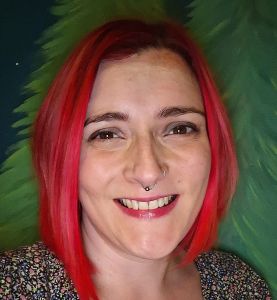
Caroline Ashley is a clinical psychologist who works for the NHS in Scotland. She primarily writes fantasy with the occasional foray into sci-fi and horror. Her favourite authors will always be JRR Tolkien and Terry Pratchett but she also has a soft spot for the romantasy genre. If she had any spare time around raising her two young children, she would spend it playing board games.
 Caroline Ashley