Ever since I was able to write, I wanted to tell stories. As a child, I would sit with notepads and pencils and scribble away, writing about people and places that only existed within my own imagination. The stories that I write even now are informed by the stories that I put down on paper all those years ago. But why? Why are so many of us compelled to write about faraway lands and wild adventures?
As a psychologist, I know that there are many different ways to answer that question. We could consider the science of the human brain and its evolutionary drive to recognise pattern and meaning in the world around us. We could consider the social aspect of sharing knowledge and experience as well as building links with those around us. We could also consider the developmental benefits of building empathy and understanding of the perspectives of others. So where do you start?
The History of Storytelling The earliest known cave paintings date back over 60 000 years. The earliest painting depicting what could be described as a story was found in the Indonesian island of Sulawesi and dated to around 44 000 years ago. Back then, homo sapiens and neanderthals were still duking it out for supremacy and human language was in its infancy, so our stories were probably similar to what has been seen in other animals. For example, monkeys have specific calls to indicate certain predators and can combine them to communicate more complex messages. Bees dance with each other to share information about pollen sources and make decisions about search strategies. These are the stories told to help us survive. True tales of where to find food, where our enemies might be, and where might be safe to sleep at night – shared with those who are important to us.
But the stories humans now tell are far more complex than that. So what changed?
The Power of Language
When us humans tell stories, we tell allegories. We share ideas rather than events or locations. We tell stories that teach us how to behave, like The Boy Who Cried Wolf – act like him and no one will trust you. We tell stories that warn against conflict and pride, like Romeo and Juliet – forgive past sins or your children may suffer. We tell stories about coming of age like Peter Pan – childhood is fun but we all must grow up. All of these stories require a level of communication far beyond what we have seen in other animals. They require an ability to use language not just to describe what has come to pass but people and places and events that have never existed and are outside the experience of both the storyteller and the reader.
Many animals’ communication is so far removed from our own that we can never be sure what goes on in their heads, but we do know a little about primates. There are examples from the 1970s to 1990s of primates (like Koko the gorilla, Washoe the chimpanzee and Kanzi the bonobo) who had been taught sign language and human language and learned to communicate with the primatologists working with them. None of them exceeded the level of a young child in terms of their communication level, but they were reported to engage in forms of pretend play, an early stage of the use of imagination. The most common example of this was in pretending that an object was something other than it was. The unique thing about this behaviour was that it was also something linked more with social interaction than with survival – for example, dolphins have been shown to engage in novel behaviours for rewards; and rats have been shown through brain studies to plan out maze routes in their heads before traversing them, again for a reward at the end of it. There is no obvious reward in pretending that a brush is a book, other than in how those around you react to your ‘game’.
But if you’ve spent any length of time with a four year old, you know that object substitution is nothing next to the range of creative play that a human child can engage in. My son regularly creates items out of thin air that he expects me to interact with and tells me that he is off to his grandparent’s house, which is actually a den he’s created in the corner of the room. He pretends to be a shop keeper, a bus driver, a dog. He role plays stories with his stuffed animals – talking for them so that they can hold a conversation.
Humans are likely the only animals in the world who are capable of telling these symbolic tales of fictional events, because we’re the only ones who have developed our language to the level required to do so. As our brains developed into what they are now, they prioritised the use of language, not just to communicate about a tangible past and present, but to imagine other possible presents and futures. The symbolic nature of the language we use allows for our stories becoming symbolic as well. When I say “remember the boy who cried wolf” you know that I don’t trust what you’re saying and my words evoke an idea of the outcome of continuing to lie. When you read the story of a brave hobbit travelling with his companion to destroy a ring, you know that the story is really about the loss of innocence, the dying of the old ways, the importance of friends to support you when challenges stand in your way.
But in the end, our stories, no matter how complex or allegorical, are attempting to achieve the same thing as our animal cousins. They teach us messages about the life that we live, the people we want to befriend and the dangers that we want our children to avoid. They tell us the behaviours that might reap rewards from those around us or warn against behaviours that will lead to harm. They also tell us something about the person telling the story. In much the same way as the bee dancing to tell its companion of a pollen source that only it has found, we are unique in the stories that we’re able to tell. We filter our warnings and our teachings through a frame of reference that only we ourselves have truly experienced.
The Desire To Be Remembered
Which leads me to why I believe that we still tell stories. Why we don’t just rely on the ones already written, the ones shared in our communities so much that they have become symbols in their own right. We tell stories so that people will know who we are and understand the world from our unique points of view. We use them to bond with others, to communicate something about ourselves. We instil our hopes and dreams into words and cast them outward, looking for people who share an affinity for those dreams.
And this is true even of the introverted writers like my teenage self, scribbling away on my own, my work locked away from view. I may have never shared those teenage stories but they were the starting point for other stories, other attempts to reach out and connect with like minded people. And even stories still to be shared, much like the cave drawings on the walls, are written in the hope that one day someone will read what our minds have created and know something of who we were.
Meet the author
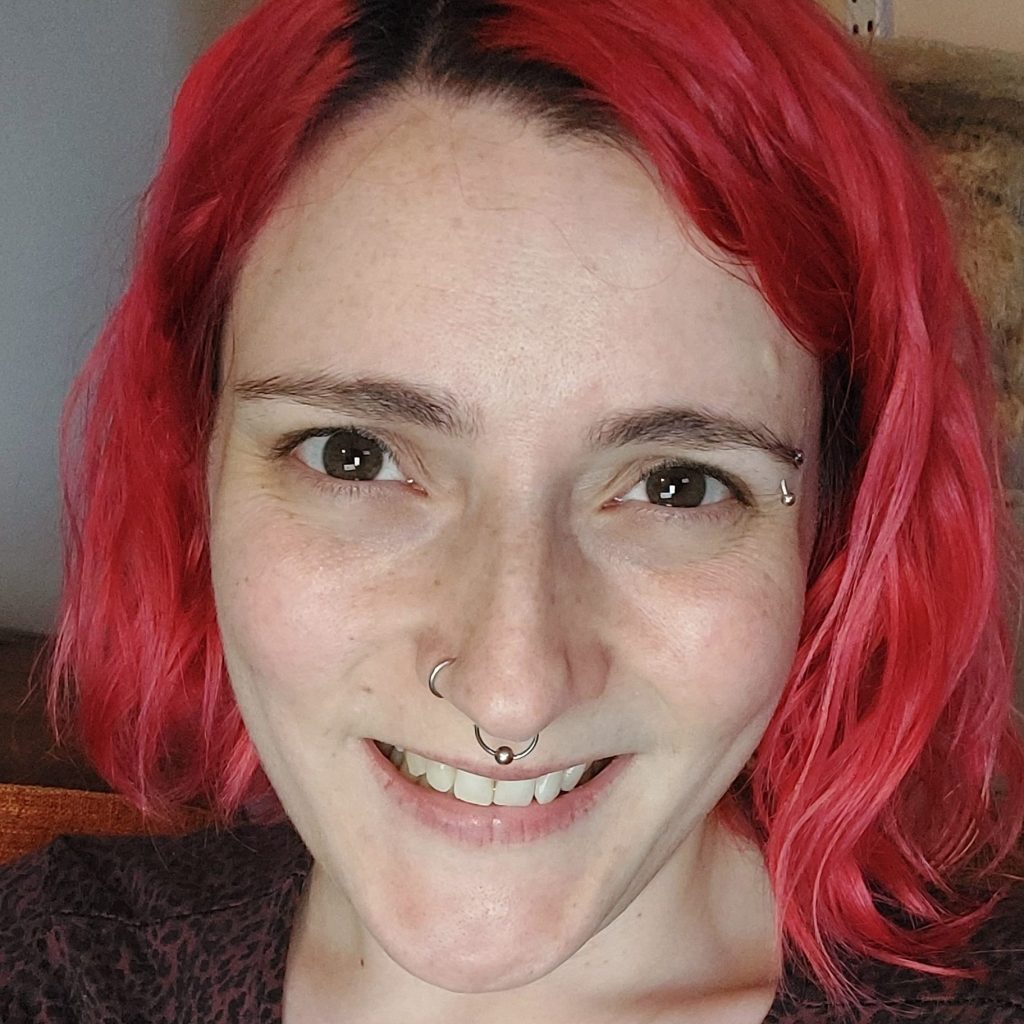
Caroline Ashley is a clinical psychologist who works for the NHS in Scotland. She is also a lover of fantasy in all forms and fascinated by the ways in which the fantasical can speak to our everyday lives.
Three weeks back at work and totally knackered 😴 I thought about posting something about the experience, and even had a few paragraphs drafted, but writing a blog about being an NHS psychologist is a very different track from the one I had planned when I started this. Suffice it to say, there are too many patients, not enough staff and not enough time. I spend my days trying to prioritise as well as I can and always leave with a list of more things to do the next day, that would ideally have been done already 🤷♀️
In terms of writing, I’m working on a story about grief that was originally for a particular magazine but ended up longer than their word limit, so now will need to find a new home. My productivity won’t be what it was last year, but I have plans for a magazine in June; a contest in July and then another contest in September. Wish me luck keeping to those plans!
I also had some good news in that one of my flash fiction stories, called ‘The Unicorn in the Garden’, was accepted for Flash Flood 2023. The Flash Flood Journal will be posting a new flash fiction piece every 5-10 minutes for twenty-four hours on the 24th June in celebration of National Flash Fiction Day. My story will appear at 6.40am BST 🙂 This story was written for a contest where it didn’t even reach the longlist so it’s nice to know that someone out there liked it – hopefully readers will appreciate it too!
I also plan to start a blog called “Storytelling”, stylised with a psi symbol for the ‘i’, just to be all fancy like.
I have drafts for the first 3 posts and I plan to post on a monthly basis, a couple of weeks after each chapter of George Square. I’m not really one for blogging but my hope is that the more I say the more readers might find my work. The blog will be an attempt to combine my two interests of psychology and writing in various ways – hopefully I don’t run out of ideas too quickly! I’m still working out how to make it look all nice on the website but hopefully I’ll get that figured out in the next couple of weeks 🙂
My first blog post on this site was published on the 9th May last year, when my daughter wasn’t even two months old. She’s now had her first birthday and I’m about to head back to work – into the breach of NHS Child and Adolescent Mental Health. While I find my work rewarding, it’s also stressful, demanding and time-consuming. I would love to live in a world where I could be paid enough to write fiction and stay home with the kids (with a few days of nursery included – the kids are also stressful, demanding and time-consuming 🙈)
Last year, when I started this, I wasn’t sure how far I would get with it, what with looking after a newborn while also having a toddler to parent. Now I wonder if I can keep the momentum now that I have a toddler and a preschooler and also need to go to work!
The traffic to my site is still small numbers. I’m hoping to get more shorter fiction published and improve that, but the route to publication, even for short fiction, is full of rejections. I’ve also considered writing a proper blog incorporating some of my psychology knowledge, but is that just another thing that distracts from writing the novel? 😅
If you would like to read my published short fiction, you can find it here
I said in my last blog post that I probably wouldn’t update George Square this month and sadly I was correct that I wouldn’t have enough time for it. Completing the two science fiction stories for Globe Soup took far more of my headspace than I had hoped that it would. It was also a quite difficult month for me on a personal level. My beloved Siamese cat, Loki, fell unwell and we had to make the heart-breaking decision to put him to sleep. He and his sister have been part of my family for nearly 11 years, adopted as kittens and always there to greet me through my day. I miss his cute fluffy face and his demanding cries. So having stories that I was busy trying to complete was a bit of a blessing, since it gave me something else to concentrate on. Now that the deadline has passed, I feel that I have two quite good (or I think they are anyway!) sci-fi stories that I can submit to magazines once the results of the contest are announced, so it has hopefully been worth all time and effort.
In terms of writing, my main other achievement this month has been a further publication – Spillwords.com have published a piece of flash fiction that I wrote called ‘Chosen for greatness but by whom?‘. Originally written for a micro contest on the theme of ‘Luck’, I found myself considering how it might feel to grow up as a destined hero, with all the heavy expectations that come with it and whether your faith in that destiny might ever waver.
My plan for the next month is to get back into writing George Square so that I keep up with my self imposed schedule.
If you’re new to George Square, the first chapters are available to read here

 Caroline Ashley