Lost in the world of novel writing

I realised that it’s been a while since I posted on my personal blog. Things have been relatively quiet here. I haven’t entered many contests and there’s not been any new publications to update about. However, I did get the good news last week that I had received an honourable mention in the L Ron Hubbard Writers of the Future contest for the second quarter of 2024. This is a well-known international contest, so being recognised for my work is a big confidence boost!

Otherwise, I have mostly been working away at completing my novel.

Tentatively titled “Battle Scars”, it’s the story of a woman named Rebecca Mason. She nearly died five years ago when a man named Rafe McKendrick brutally attacked her. His twin brother, Erik, saved her by turning her into a werewolf and Rafe was exiled from his pack. Rebecca struggles every day to reconcile her human life with the supernatural world. And then one day, Rafe comes back, and he’s threatening not just her but her new found pack and all of werewolf society. Does she have the strength to stand against the man who nearly killed her?

The novel is now written and one of my lovely fellow writers is reading it to give me feedback. There’s bound to still be plenty of editing to do but having a finished novel feels almost within reach!

On top of that, I’m also working on the sequel, which has a different point of view character. A gamble maybe, because I know people like having a single protagonist to follow, but it feels the right thing for the series I want to tell, so hopefully it works once it’s written! My aim for this book in terms of writing skills is to improve my efficiency, getting it written within a faster timescale by doing more planning at the beginning instead of just pantsing my way through it πŸ™ˆ If I can write faster, I’ll be able to get more books written in the long run so it’s definitely worth making myself more organised!

Look out for another Storytelling blog post, which I will try to get completed this week if I can pull my focus away from the novel writing 😊

Navigation

Let Me Tell You My Story: The First Person Narrative

For the last few posts I’ve been discussing the importance of the point of view that a story uses and how narrarive perspectives can impact the story. We’re now onto the last perspective that can be used in story telling, which is first person.

What is a First Person Narrative?

First person perspective is when the story is written with the narrator as the protagonist who has experienced or is experiencing the events of the narrative. It is an intimate perspective, designed to elicit the experience of the reader being told a first person account of a story, with access to the narrator’s thoughts and feelings throughout.

One mistake at the end of my life couldn’t erase all the times I had stood unmoved at the edge of the abyss and made snide remarks at its expense. They could kill me, but they couldn’t have me. I was my own.

Ghost Story – Jim Butcher

To imagine a book as a real life scenario, in first person narratives you are sitting down next to another person and that person is sharing a piece of their life story, including both the events and their own thoughts and feelings at the time.

Why use a first person perspective

The intimacy of connection

The most obvious advantage of this perspective over others is how closely connected you are with the narrator. This is a far more intimate perspective than even third person limited (which I discuss here) because the narrator has invited you in, they’re actively telling you their story and sharing their experiences. As a reader, you’re not just observing what happens: you’re being asked to share in it.

From a psychological perspective, humans are profoundly social species. Our brains are wired to  connect to others and experiencing that connection has been shown to activate brain areas associated with physical safety and warmth.

A first person narrative is an extreme in human connection. A person who is willing to share every little detail of their experience with you, right down to their personal thoughts and feelings. As a social animal, we’re likely to find this highly rewarding – provided we see something in the story that we’re interested in connecting with.

Detailed Character Development

First person narratives allow for a detailed exploration of the narrator’s character, in a way that no other perspective does.

There are several examples where the first person perspective exposes us to detailed elements of the narrator’s thinking style and personality that we wouldn’t really have access to otherwise.

One would be The Curious Incident of the Dog in the Night-time, which is narrated by an autistic teenager and gives unique insights into his perspective of the world around him.

I like dogs. You always know what a dog is thinking. It has four moods. Happy, sad, cross and concentrating. Also, dogs are faithful and they do not tell lies because they cannot talk.

The Curious Incident of the Dog in the Night-time – Mark Haddon

The premise of the book stems in part from his own unique viewpoint – when he finds a dead dog, he sees it as a murder and sets out to investigate and find the killer.  Even the way in which the narrative is presented offers insight into the character that the reader might not otherwise have access to – such as the way that he describes his thoughts and experiences using diagrams.

Of course, the flip side of such a personal account is that it’s inherently biased and potentially unreliable. As far as our social brains are concerned, that’s part of the fun. We love puzzles and gain satisfaction from solving them. Solving social puzzles has the additional benefit of adding to our understanding of other people – so if we distrust an unreliable narrator, we feel rewarded to be proven right; or if they catch us out, we get the buzz from the shock of the surprise.

One well-known example of an unreliable narrator is Pi Patel from The Life of Pi, who recounts his fantastical story of surviving stranded at sea with a tiger named Richard Parker and then presents an alternative, more realistic but also more brutal, version of events and we as readers need to decide which we would prefer to be true.

I was giving up. I would have given up – if a voice hadn’t made itself heard in my heart. The voice said β€œI will not die. I refuse it. I will make it through this nightmare. I will beat the odds, as great as they are. I have survived so far, miraculously. Now I will turn miracle into routine.

The Life of Pi – Yann Martel

Only in a first person narrative could a story be called into question to such a degree. Most other perspectives lead to an assumption that the story is being observed in some way by the reader, albeit with a potentially biased filter imposed by the narrator. Whereas in first person, we’re living in someone’s mind – and we all know how inaccurate our own perceptions can sometimes be!

Societal Issues at an Individual Level

Another powerful use of a first person narrative is to use the individual narrator as a  way to speak to a wider societal issue, either as a form of analysis or critique.

A wonderful example of this is Never Let Me Go by Kazuo Ishiguro. This book explores the lives of Kathy and her friends, who are clones created to be organ donors. In her world, they are seen as less than human. Kathy’s role is to care for and reduce the β€˜agitation’ of fellow donors. She is never in a position where she can fight against her place in society but her own first person narrative does that for her – it humanises her and her friends, connecting the reader with them in a way that those in her world refuse to.

Or another example would be Fight Club by Chuck Palahniuk. An unnamed narrator, who feels disenfranchised from society and its definitions of manhood, turns to Tyler Durden. Tyler Durden starts a fight club and then a cult-like organisation, which engages in increasingly dangerous anti-consumerist attacks. At first, the narrator seems to be just another follower of Durden, until it emerges that he has dissociative identity disorder and he and Durden are the same person.

The first person perspective gives the reader a unique insight into the mind of the narrator, seeing the world as he convinces himself it is, rather than how it really is. We follow along with him, watching Durden grow increasingly out of control. Even once the narrator knows the truth, events have already moved beyond him, leaving him just as helpless in the face of Durden’s actions as he was in the face of the society that he struggled to fit in to.

What first person perspectives can’t do

By definition, this perspective is the story of one person. Everything that the reader sees has to have been seen by them. While events could be shared with them by other characters, if a lot of action happens away from the narrator then this can leave the reader feeling disconnected from the story.

This means that the narrative in a first person story is often narrower in focus than other perspectives. In third person limited, the camera might pick up on details that the protagonist misses. In third person omniscient the narrator can see anything that they need to for the sake of the story. Even second person can take on a more omniscient form when required.

One solution to this is to include multiple first person perspectives, like in Gone Girl by Gillian Flynn, which relies heavily on both narrators being unreliable and obscuring the reality of the story. This can work well as a way to tell an immersive story from multiple angles, building a wider picture than with a single point of view. However, there is a risk of confusion for the reader in terms of who is speaking and when, which means that in many cases third person is often easier – allowing the narrative to follow the protagonists closely without any confusion around which character is the current focus.

More generally, some people can find a first person perspective to be too immersive and can be put off by the story as a result. They may not connect with the narrator or they may feel frustrated that they aren’t seeing aspects of the other characters’ stories. Therefore it has to be clear why those other aspects are less important to the themes of the story than the mind of the narrator itself, or people may struggle to join the narrator on their journey.


Β About The Author

Caroline Ashley storytelling blog author

Β Caroline Ashley is a clinical psychologist who works for the NHS in Scotland. She enjoys all forms of fantasy and is fascinated with the ways in which the fantastical can speak to our everyday lives. If Caroline had any spare time around work, writing and raising her two young children, she would spend it playing board games.

Navigation
 

‘They Do Not Know The Earth’ and other things

If you follow me on social media, you’ll have already seen that the Hooghly Review have published one of my stories in their 3rd issue, which was released today. ‘They Do Not Know The Earth‘ is a flash fiction piece about a witch grieving for her lost family and trying to use magic to fill the hole they’ve left.

I’m aware I’ve been pretty quiet of late and I’m planning to attempt to get back on track this month. My writing has still been a priority but I was taking part in a free five day challenge with Writer’s Ink, as well as attending workshops organised as part of ProWritingAid’s FantasyΒ  Writers Week. Both have provided some useful insights into writing longer fiction as well as the publishing and marketing side of the journey, which I’ll hopefully be able to use to my advantage with time!

It can be a bit overwhelming how many things are out there to help you with your writing – writing groups that you can subscribe to; apps for editing; apps for world-building; apps for structuring and planning. Not to mention the people you can pay for various kinds of editing and support in getting your book ready to go to agents. At the moment, I’ve resolved to try and do as much as I can without all that, just plugging away at my writing and editing, while attempting to get better at the whole social media thing and build some followers. Let’s see how it goes!

The next post after this will be for my Storytelling blog, on the topic of Third Person Omniscient Point of View, which I’m hoping to get out to you in the next couple of weeks. After that, we should be back on the usual monthly schedule. Any suggestions for topics to cover in Storytelling are more than welcome, so leave me a message with what you’d like to hear about.

Navigation

Take Me Home

My latest publication is out now! Take Me Home is a flash fiction piece about the moments we lose as time passes and that desire to recapture that feeling of being “home”.

It’s been published in the 4th issue of Raw Lit Mag, which has some great stories about some of the hard realities of life and how we deal with them. Big thanks to the editor, Delphine Gauthier-Georgakopoulos, for all her time spent pulling this issue together ❀️

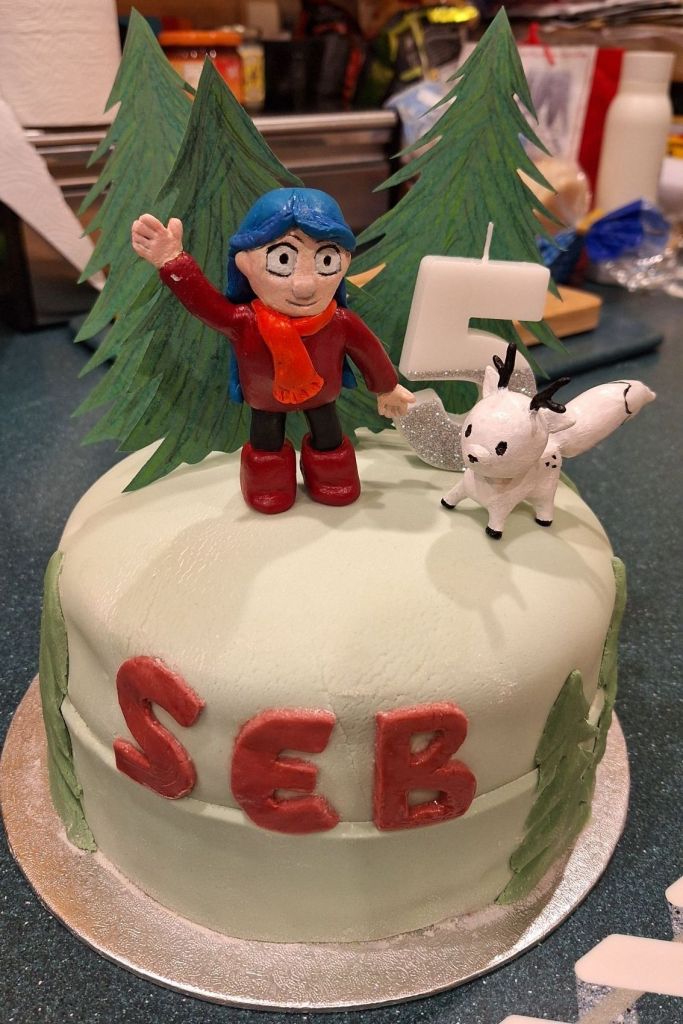
On the related note of moments that we want to hold onto, my son turned five yesterday. We had a small party with friends and family and he seemed to have a wonderful time. He requested a cake themed around a Netflix TV show called Hilda that we’ve been watching together as a family. It’s a lovely show, based on a comic book by Luke Pearson, about a girl who goes off on adventures in a world where magical creatures like elves, trolls, nisse and fairies all exist. Exactly the kind of story I love! I would highly recommend it even if you don’t have children.

The result of evenings slaving away making clay figures for my son’s cake πŸŽ‚

How theory of mind leads to effective storytelling

Storytelling is all about sharing a point of view. When we read or listen to a story, we’re learning something about the perspective of the storyteller or their characters. Stories can make us feel connected to the protagonist; they can build anticipation for the ending; they can make us question our views of the world. But what is it that that makes stories so effective in triggering these thoughts and feelings?

What is Theory of Mind?

Communicating a point of view in a story starts with theory of mind. Every human has the capacity to put themselves into the mind of another, to consider that someone else might have a different perspective to them. We develop this skill as children, with some of us being better at it than others for various social, environmental and cognitive reasons. The concept of theory of mind relates largely to cognitive perspective taking. This means it relates to interpreting the thoughts, desires and intentions of others, which we use to infer reasons for their behaviour or to predict their behaviour. Psychologists describe it as a theory because it’s impossible to ever truly prove our assumptions about another person’s mind – we’ll never see or experience it the way they do.

Another related concept is empathy, which researchers describe as emotional perspective taking. This is our ability to recognise and understand the emotions of others, basically to put ourselves in someone else’s shoes and consider how a situation might make them feel.

Theory of Mind and the Role of Language

In my previous blog post Why Do We Tell Stories, I wrote about the power of language. We are the only animal that we’re aware of that’s capable of communicating complex symbolic meanings. We are capable of describing events that have never happened, or that we have never experienced, in order to express an underlying message to our audience.

In the same way, this linguistic ability gives us the framework for conceptualising the experience of another person. Other animals have been shown to have some theory of mind, for example, crows are able to infer that another crow may not have the same knowledge as them; chimpanzees and bonobos have shown some ability to infer the intentions and emotions of others. But researchers all agree that the theory of mind these animals evidence is far less than that of humans. We don’t really know for sure why that is, but there does seem to be a strong link between language fluency and the development of theory of mind and empathy.

As we’re teaching our children to speak, often we’re also teaching them something about theory of mind at the same time. For example, when my son starts crying and I ask β€œAre you sad?, I’m giving him the label that I use to describe that emotion in myself. If I’m combing his hair and pull too hard, I’ll say β€œSorry, I didn’t mean to hurt you” and he’ll know that what happened wasn’t my intention. When I plan to have toast and realise there isn’t any bread, if I say β€œI didn’t know you and Daddy finished the bread”, I’m teaching him that my knowledge was different to his until I went into the kitchen. Language allows us to access the inner worlds of other people in a way that just wouldn’t be possible otherwise.

Theory of Mind and Storytelling

Another thing that researchers have found is that our brains are particularly interested in narratives. Partly, this is because they’re easier to remember: they have a structure that we can follow and a context that we can put them in. But it’s also because narratives have a social value. We tell stories to share information about ourselves or our experiences, and we find stories engaging because there’s an evolutionary advantage to being given the information that others want to share. In the past, that might have been information about food sources, or whether other people were trustworthy, or signs of a predator. Now, our stories might be more complicated but we still listen to them to build our social understanding.

Brain imaging studies have shown that when we listen to narratives rather than just unrelated verbal information, different areas of the brain are activated. This extends even to fictional stories. When we are told about the thoughts, feelings and behaviours of a character, our brains work to take their perspective in the same way we would with a real person. In this way, simple stories can be used to help children to practice theory of mind and develop their social and emotional understanding of others, while adults can emotionally connect with characters, allowing stories to take on more meaning and become more memorable.

Point of View

Within storytelling, there are three main points of view that a narrative can take:

First Person:

This is the point of view that you’re most likely to hear in stories told during your everyday life. It is a story where the narrator is also the protagonist and they are telling you about something that happened to them e.g.:

I did the only thing any reasonable wizard could have done. I turned around and ran like hell.

Jim Butcher

Second Person:

In this point of view, the narrator turns the reader into the protagonist, speaking as if the reader themselves were the one who experienced the narrative.

You’re still trying to decide who to be. The self you’ve been lately doesn’t make sense anymore; that woman died with Uche.

N.K. Jemisin

Third Person:

The most commonly used point of view in fiction, third person provides the reader with a camera through which they can see the action happening to the characters in the narrative. This perspective is similar to our usual life experiences: we watch others as they speak and act, separated from them unless they tell us their own first person account.

Bilbo was very rich and very peculiar, and had been the wonder of the Shire for sixty years, ever since his remarkable disappearance and unexpected return.

J.R.R. Tolkien

How do theory of mind and point of view interact with each other?

Each different type of point of view invites the reader to engage with a narrative in a particular way and each will require different aspects of theory of mind.

In first person POV, we’re being told someone’s story. They’re making a direct attempt to share something of themselves with us. This taps into our social desire to engage with, empathise and understand those around us, and to build human connections.

In second person POV, the narrator asks us to imagine that we are the protagonist, to put ourselves in the narrative. This is a tricky one to get right, if the actions of the character are too far removed from what we think our own might be, but it can have the powerful effect of leaving us feeling like we personally understand the experience of the story.

Third person POV draws on the skills we use every day in observing those around us but often with the added element of access to the internal experiences of the characters, which generally makes us feel more emotionally invested in them.

The point of view that is most effective for the narrative being told is dependent on the aims of the storyteller, but all of them take advantage of our ability to take the perspectives of the protagonists and empathise with their experiences.

Navigation:

About the Author

Caroline Ashley Author storytelling blog

Caroline Ashley is a clinical psychologist who works for the NHS in Scotland. She loves fantasy in all forms and is fascinated by the ways in which the fantasical can speak to our everyday lives.

Happy summer!

(AKA my blog post is late because I was on holiday)

Due to having two young children, we decided to stick to the UK for our holiday this year, to save ourselves the joy of navigating an airport and a flight with our delightful, independently-minded monsters. So we spent a week in Dumfries and Galloway instead.

Looking at the weather forecast, we thought we were going to end up with it raining all week, but the weather gods were clearly in a good mood and granted us some lovely days (interspersed with rain of course, it is the West Coast of Scotland after all).

Sandhead Beach

I often went on holiday with my family to Dumfries and Galloway as a child, so it was a bit of a walk down memory lane too. I hadn’t visited this neck of the woods in years so it was interesting to see what had changed and what had stayed the same.

I wrote quite a lot when I was little and often went on holiday with a notepad and pencil, drafting stories while my dad fished off a pier or a beach. The idea for the world of George Square is one that I’ve been playing around with since the time of our holidays down there.

I would sit in the car, watching rows of evergreen trees fly past and imagine a castle hidden from view, where my characters all lived. I would scramble over jagged rocks, listening to the roar of the sea, and imagine some of their adventures to dangerous places, far from home.

Isle of Whithorn

But on this holiday, I mostly spent my time entertaining a 1 year old and a 4 year old, so not much actual writing was achieved. Once they were in bed, my husband and I spent our evenings relaxing in a hot tub with a glass of wine and revelling in the beauty of the countryside.

Normal activity should resume for now, though we’re taking another week away next month so we’ll see when I get the next post out!

Or why not check out my other published work while you’re visiting 😊

*

What is a story?

When I started thinking about this blog, I considered the ways in which a psychologist could contribute to our understanding of storytelling. My initial thought was that most topics would relate to characters and characterisation, after all, psychology is all about people, isn’t it? But then it occurred to me that the psychology of a reader may be just as important to a successful story as the story itself. A five year old would be unimpressed by a 100 000 word tome; an avid science fiction reader likely won’t find much to engage with in a chick lit novel.

I also realised that my first blog post started with the premise that everyone already understood what a story was. And perhaps we do. Perhaps we grow up so surrounded by stories that the concept doesn’t need to be explained. But consider the example of language fluency – it is possible to be fluent in English but to not understand the difference between past perfect and past continuous, and to not be able to put into words why it doesn’t sound right for someone to be wearing a β€œred, old, big coat”. You might know English, but you would perhaps struggle to teach its nuances to a class of English learners. So I thought I would share some thoughts about what stories are.

How do stories begin (and end)

Generally stories are a description of people and the events that happen to them, whether real or imaginary. Stories always have a purpose. Often they are told in order to share some understanding of the world we live in. Even stories that seem to have no strong purpose, light hearted and funny, tell us something about the storyteller or the characters within the story.

But none of this tells you anything really about what a story will look like. And the thing is, we do have expectations around the form that a story will take. Generally a reader (or listener) starts a story expecting it to contain a beginning, middle and an end, although not necessarily in that order, if the storyteller is feeling particularly avant garde.

We want to know who the main character is, what the setting is, and what problem the character is facing. And most of all, we want to know how they solve the problem. We want to be taken on a journey that gives the character resolution and teaches us something along the way.

When we start a story, if there’s no real conclusion, it generally feels like we’ve wasted our time. I’m sure many Netflix subscribers have grown used to that disappointment lately and started to turn away from them as a media source – because what’s the point if they never give you a completed story?

The importance of the ending

A story without an end is a story without meaning or purpose. How can we know what lesson we were supposed to take from a narrative if the writer doesn’t give us the ending? How can we better understand who the writer is if we don’t know how they wanted their story to go? Our lives are not as easily separated into discrete entities, but we expect the stories that we tell about these lives to be compartmentalised regardless. Because in doing so, our experiences become something that we can learn from, move on from, and then share as a warning to others who might follow the same path.  

The lack of ending, or lack of closure, is often a reason that people struggle after a negative life experience. We want there to be a reason. We want to know what the lesson is. We want to know how to avoid it happening again. We want our life to be a story, broken into neat chapters, each with its own purpose. The girl who’s father left her wants to be an independent woman who doesn’t need men to define her. The man who lost his job wants this to be an opportunity to build a new career. And if our lives can’t be as clearly delineated as that, the lives of our fictional protagonists should be.

Or, to think about it another way, perhaps we use these fictional narratives in order to work out how to compartmentalise the sections of our own lives. If the only narrative sense our lives really have is the one we make up in our own heads, then the more experience that we have with narratives, the better we will be at sustaining the one that defines us.

Story Archetypes

And that leads to another aspect of reader expectation – story archetypes. Literary theorist Christopher Booker posited seven story archetypes which appear across the history of human storytelling:

  • Rags to riches – the underdog gaining power or privilege temporarily, then finding a way to gain it back for good
  • The quest – a journey to obtain a certain outcome or object
  • Rebirth – the hero experiences an event that leads them to change their ways
  • Overcoming the monster – where the hero has to defeat the antagonist that threatens them
  • Comedy – a triumph over adverse circumstances, leading to a happy ending
  • Tragedy – the downfall of a hero who either has a character flaw or makes a mistake so large it leads to their undoing
  • Voyage and return – a journey to an unfamiliar land, where the hero learns something then comes home more knowledgeable than before

Not all stories fit neatly into these categories. Probably because trying to categorise the human experience of storytelling is akin to telling a story in itself.  We bring our own unique view points to our interpretation and may not come up with the same outcome. But, this theory highlights the important point that readers have expectations. If a hero goes on a quest, we expect to know how it ends – we would be pretty annoyed if he gave up halfway through and just went home. Unless of course we were reading a Rebirth story, where the protagonist sets off, determined to kill a monster, then realises killing isn’t for him. But if you don’t set the reader’s expectations towards the right archetype, they’re still going to be disappointed with how it plays out or may disengage from the story entirely.

Stories are conversations

This leads us to the most important part of what a story is. A story is a shared experience, one that means nothing without a reader or listener to appreciate it. We tell stories to teach lessons; we tell stories to warn of danger; we tell stories to share a piece of who we are with the people around us. But none of that means anything if our story isn’t entertaining enough for someone to listen to it in the first place.

A story, ultimately, is a conversation. It is an attempt by a writer to communicate something that they believe is important, to someone that they believe might benefit from what they have to say. Without a willing reader or listener, the story might as well be screamed into the void or tossed on a fire to burn. And in return, as a reader, we want to be exposed to the narratives we expect, that give us a sense of closure and help us to in some way make sense of our own journey through life. If we cannot in some way incorporate the meaning or structure of a story into our own experience, then what was the point of the story?

Of course, there are far more facets to storytelling than just this, that could be analysed at the micro and macro level. But none of those factors mean anything if you don’t have two people, the reader and the writer, willing to communicate with each other.

*

If you’re interested in any previous Storytelling posts, you can find them here

Or why don’t you check out my young adult fantasy novel, George Square, or my published short fiction.

*

Meet the author

Caroline Ashley is a clinical psychologist who works for the NHS in Scotland. She is a lover of fantasy in all forms and fascinated by the ways in which the fantasical can speak to our everyday lives.

One year anniversary

Three weeks back at work and totally knackered 😴 I thought about posting something about the experience, and even had a few paragraphs drafted, but writing a blog about being an NHS psychologist is a very different track from the one I had planned when I started this. Suffice it to say, there are too many patients, not enough staff and not enough time. I spend my days trying to prioritise as well as I can and always leave with a list of more things to do the next day, that would ideally have been done already πŸ€·β€β™€οΈ

In terms of writing, I’m working on a story about grief that was originally for a particular magazine but ended up longer than their word limit, so now will need to find a new home. My productivity won’t be what it was last year, but I have plans for a magazine in June; a contest in July and then another contest in September. Wish me luck keeping to those plans!

I also had some good news in that one of my flash fiction stories, called ‘The Unicorn in the Garden’, was accepted for Flash Flood 2023. The Flash Flood Journal will be posting a new flash fiction piece every 5-10 minutes for twenty-four hours on the 24th June in celebration of National Flash Fiction Day. My story will appear at 6.40am BST πŸ™‚ This story was written for a contest where it didn’t even reach the longlist so it’s nice to know that someone out there liked it – hopefully readers will appreciate it too!

I also plan to start a blog called “Storytelling”, stylised with a psi symbol for the ‘i’, just to be all fancy like.

I have drafts for the first 3 posts and I plan to post on a monthly basis, a couple of weeks after each chapter of George Square. I’m not really one for blogging but my hope is that the more I say the more readers might find my work. The blog will be an attempt to combine my two interests of psychology and writing in various ways – hopefully I don’t run out of ideas too quickly! I’m still working out how to make it look all nice on the website but hopefully I’ll get that figured out in the next couple of weeks πŸ™‚

Check out my published fiction here.

Nearly one year on…

My first blog post on this site was published on the 9th May last year, when my daughter wasn’t even two months old. She’s now had her first birthday and I’m about to head back to work – into the breach of NHS Child and Adolescent Mental Health. While I find my work rewarding, it’s also stressful, demanding and time-consuming. I would love to live in a world where I could be paid enough to write fiction and stay home with the kids (with a few days of nursery included – the kids are also stressful, demanding and time-consuming πŸ™ˆ)

Last year, when I started this, I wasn’t sure how far I would get with it, what with looking after a newborn while also having a toddler to parent. Now I wonder if I can keep the momentum now that I have a toddler and a preschooler and also need to go to work!

The traffic to my site is still small numbers. I’m hoping to get more shorter fiction published and improve that, but the route to publication, even for short fiction, is full of rejections. I’ve also considered writing a proper blog incorporating some of my psychology knowledge, but is that just another thing that distracts from writing the novel? πŸ˜…

If you would like to read my published short fiction, you can find it here

Sci-fi is difficult to write!

This update is late, I know!

At the beginning of the month I decided to get a draft completed for one of the sci-fi stories that I’m writing for Globe Soup’s latest contest, thinking it would just take me a few days. How wrong I was. Who knew how much research would be required to write a short story related to terraforming? (Probably most people, I imagine 🀣) First I had to decide where was being terraformed, how it was being terraformed, how the characters were surviving pre-terraformation, as well as working out the story within that! Thankfully I do have a draft now but I definitely didn’t enjoy expanding my scientific knowledge and I’m not convinced it’s my strongest idea. Sadly, I also got a ticket for time travel so I’m going to have to get all sciency again before the end of the month 😭

On a more positive note, my story on 50-WordStories was chosen as story of the month, so that gave me a wee mental boost as I waded through Wiki articles on how to extract oxygen for life support systems πŸ˜„

My mind has drifted a bit from my focus on George Square due to the contests I’ve been preparing for lately – I’m not sure if that’s a good or a bad thing. On the one hand, the contests are helping me to hone my writing skills. On the other, novel writing is much more my preference over short stories and I only have so much time for writing. The problem is that a completed short story gives me a much quicker sense of achievement than trying to type my way through tens of thousands of words!

I know not many of you are reading this, so I’m sure there won’t be a momentous backlash, but I’m thinking that I’m going to skip a month of writing George Square to get my short story commitments completed – then I will hopefully power through the next few chapters. So next month may just be a wee blog post to update you on my activities but I promise normal programming will resume the following month πŸ™‚

Or check out my published short fiction here πŸ™‚